
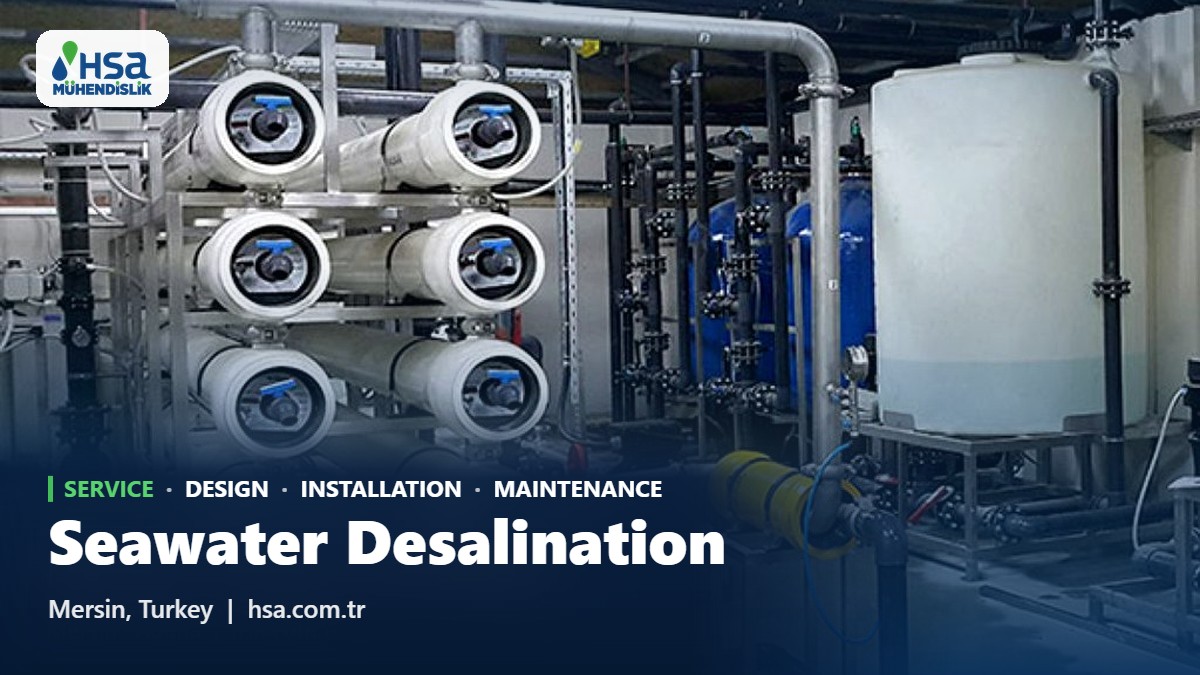
Seawater Desalination Systems
Seawater reverse osmosis (SWRO) systems turn seawater into drinking and process water for coastal facilities, hotels, islands and vessels.
Seawater contains around 35,000–45,000 mg/L of dissolved salts, far above the limits for drinking or process use. Seawater desalination systems remove these salts and other contaminants and produce fresh water where reliable fresh water sources are limited or expensive.
Why Seawater Desalination?
For coastal hotels, holiday villages, islands, industrial plants and vessels, desalination provides an independent and stable water supply. Instead of relying on trucked water or overused groundwater, the facility produces its own water on site, in the quantity and quality it needs.
How Does a Seawater Desalination System Work?
1. Intake and pretreatment: Seawater is taken from a beach well or open intake and passed through multimedia filtration, cartridge filters and, where needed, ultrafiltration. Antiscalant and other chemicals are dosed to protect the membranes.
2. Reverse osmosis: High-pressure pumps push the pretreated water through seawater reverse osmosis membranes at typically 55–70 bar. The membranes reject the vast majority of dissolved salts.
3. Energy recovery: In larger systems, energy recovery devices recover pressure from the concentrate stream and significantly reduce power consumption.
4. Post-treatment: The permeate is remineralised and pH-adjusted, then disinfected before it is stored and distributed.
Advantages
- Independent water supply: Water production on site, even where groundwater is saline or limited.
- Consistent quality: Product water quality is controlled continuously.
- Scalable: Modular skids and containerised units allow capacity to be increased as demand grows.
- Long-term economy: With proper design and energy recovery, operating costs can be lower than long-term water purchasing.
Key Design Points
- Correct pretreatment: Most membrane problems originate from insufficient pretreatment, so it is designed according to the seawater analysis.
- Quality components: Corrosion-resistant materials (duplex/super duplex stainless steel, GRP) and proven membrane brands extend system life.
- Maintenance: Regular membrane cleaning, filter replacement and monitoring keep the system efficient.
- Concentrate discharge: Brine discharge is planned in line with local environmental requirements.
Seawater Desalination by HSA Engineering
HSA Engineering designs, supplies and commissions seawater desalination systems, from compact skid-mounted units to containerised plants, sized to each project's capacity and water analysis. We support our customers with installation, operator training, maintenance and spare parts. Contact us to discuss your capacity requirements and request a quote.